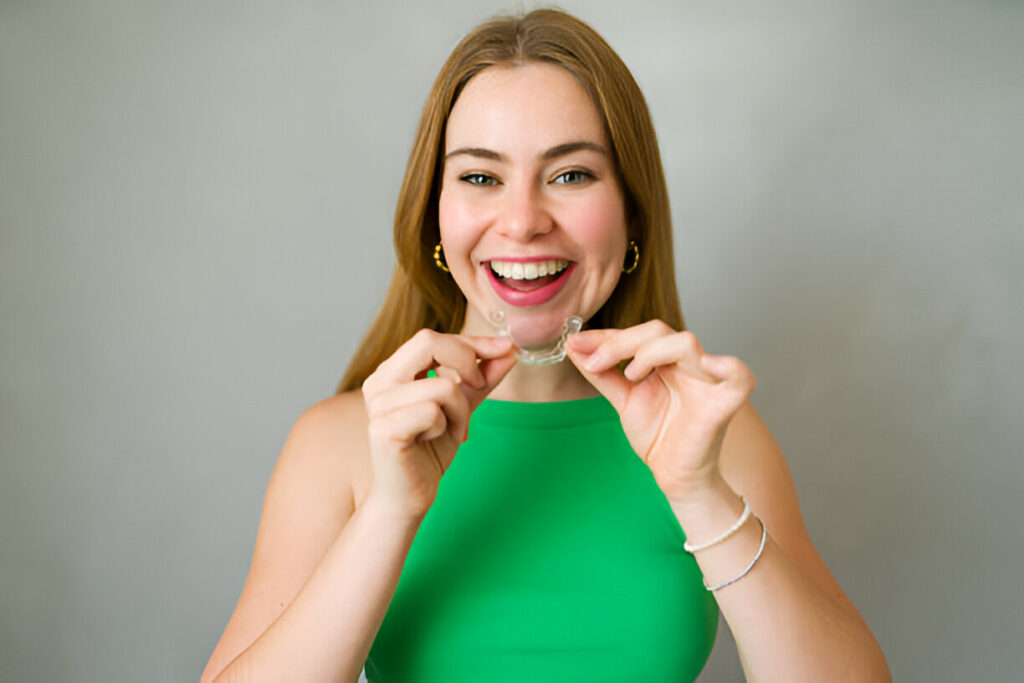
The Truth About Invisalign and Facial Changes
Invisalign straightens teeth using clear plastic aligners, but the real transformation goes deeper than you might think. At Cove Dental and Implant Centre, we’ve treated over 250 Invisalign patients, and the question we hear most often is: Will my face actually look different?
The answer is yes — but not in the way most people expect.
Your teeth aren’t just about aesthetics. They’re structural pillars that support your entire facial profile. When teeth move, your face responds. The changes are subtle, permanent, and almost always positive.
How Tooth Movement Actually Changes Your Lips and Profile. Let me explain the mechanics.
The Upper Lip Support System
Your upper lip doesn’t float in space. It rests directly against your upper front teeth. The position, angle, and projection of those teeth determine how your lip sits at rest.
When you have crowded or misaligned upper teeth, your lip often presses inward slightly to accommodate the irregular surface. This can make your smile look thin or asymmetrical, even if your lips are naturally full.
Here’s what happens with Invisalign:
As we gradually straighten your upper teeth, they create a more consistent, forward-facing surface. Your lip naturally rests against this new position — sitting slightly further forward and more evenly. The result? Your upper lip appears fuller and more balanced. The smile line becomes clearer. Your entire lower face looks more defined.
One of our most common patient observations: “I didn’t realise my upper lip was being pulled inward. Now that my teeth are straight, my smile looks completely different — and I didn’t need fillers.”
Closing Gaps Changes Your Profile Entirely
If you have gaps between your teeth, those gaps create negative space in your smile line. But they also affect your profile.
Wide spacing — especially in the upper front teeth — creates a visual separation that can make your face appear less cohesive when viewed from the side. Your lip line looks interrupted. The vertical support in your lower face weakens slightly.
When we close those gaps with Invisalign:
- Your upper lip gains continuous support across the entire tooth surface
- Your smile line becomes unbroken and harmonious
- From a side profile, your face looks more sculpted and defined
- Your chin and jawline appear to have a better proportion to the rest of your face
We frequently photograph patients from the side before and after treatment. The profile change is often more dramatic than the straight-on view.
Why Adults See More Obvious Changes Than Teenagers
This is important — and it’s a pattern we notice constantly in our practice.
Teenagers undergoing Invisalign treatment often see minimal facial changes because their faces are still developing. Their bones are more adaptable, their growth isn’t finished, and the supporting structures (jawbone, soft tissue) are still shifting naturally.
Adults see dramatic changes because:
- Your facial structure is fixed. By your 20s, your face has stopped growing. When you straighten your teeth, you’re working with a mature, stable foundation. Every millimetre of tooth movement has a visible impact.
- You’ve had years of compensation patterns. Many adults have unconsciously adapted to misaligned teeth — holding their lips differently, smiling at a certain angle, and avoiding certain expressions. Invisalign removes those compensations. You literally move your face back to its natural resting position, and it often looks transformed.
- Bite problems compound over decades. Adults who’ve lived with overbites, underbites, or crowding have experienced years of soft tissue adaptation. When we correct these issues, the changes to your jawline, cheek position, and chin definition are significant.
This is why we always tell adult patients: The transformation often exceeds expectations.
Which Facial Features Actually Change?
Jawline Definition
Bite correction — especially fixing overbites — allows your lower jaw to sit in its natural, forward position. This immediately makes your jawline appear sharper and more defined. We’ve seen patients who thought they had a weak jawline discover that their jawline was simply being held back by their bite.
Chin Projection
An overbite often makes the chin appear recessed or smaller than it actually is. As we correct the bite and bring the lower jaw forward, the chin projection improves. Your profile strengthens.
Cheekbone Appearance
When teeth are crowded or misaligned, your cheeks often rest at a slightly different angle. As teeth straighten, your cheeks settle into a higher, more naturally lifted position. Combined with improved jawline definition, this can make your entire midface appear more sculpted.
Lip Fullness and Balance
We’ve already covered this, but it bears repeating: your lips will look different. Most patients report that their upper lip appears fuller and their smile more balanced. This happens naturally — no filler needed.
Overall Facial Symmetry
Perhaps the most noticeable change: your face looks more balanced. If you had a crossbite, your face may have appeared slightly lopsided. Correct the bite, and your entire face aligns. It’s remarkable how much of facial harmony depends on tooth and jaw alignment.
What About Severe Bite Problems?
If you have a severe overbite, underbite, or open bite, the facial changes can be quite pronounced — but sometimes Invisalign alone isn’t enough.
Moderate to severe cases may require a combination of Invisalign and orthodontic support, or in rare cases, surgical correction alongside aligners. This is something we assess during your consultation.
The good news: even in complex cases, we use digital simulation to show you exactly how your face will change. You’ll see it before we begin treatment.
Are These Changes Permanent?
Yes — but only if you commit to your retainer.
After Invisalign treatment, your teeth want to drift back to their original position. This is normal biology. A retainer holds them in place while the bone around your teeth hardens and stabilises (this takes about 12 months, though retention is lifelong).
If you skip the retainer: Some of the facial changes will gradually reverse as your teeth shift back. We’ve seen this happen, and it’s preventable. Wear your retainer.
If you wear your retainer: The changes are permanent. Your new bite, your new smile, your new profile — they stay.
Will You Look Dramatically Different? Or Just Better?
Honestly? Most people don’t become unrecognisable. But almost everyone looks better — more like the best version of themselves.
The changes are improvements in harmony, balance, and proportion. Your friends will notice. They might say, “You look different — did you do something?” But it won’t be shocking. It will be: “You look great.”
And that’s the point.
Real Patient Experience at Cove Dental and Implant Centre
We had one patient — a 42-year-old professional — who’d avoided smiling in photographs for 15 years because of her overbite. After 18 months of Invisalign treatment, she didn’t just get straighter teeth. Her entire face opened up. Her jawline became visible. Her chin projection improved. She literally looks younger, not because we erased years, but because her face is finally aligned.
She cried when she saw her new profile for the first time.
That’s not unusual in our practice. It happens regularly.
Ready to See Your Transformation?
Invisalign’s primary job is to straighten your teeth and correct your bite. But the side effect — the facial changes — is often what patients remember most.
At Cove Dental and Implant Centre, we use advanced digital simulation technology to show you before we begin treatment. You’ll see exactly how your teeth will move, how your profile will change, and how your face will look in your new alignment.
This isn’t a guess. It’s a prediction based on your specific anatomy.
Book an Invisalign consultation at Cove Dental and Implant Centre — we’ll show you exactly how your smile and profile could change using our digital simulation tool. No commitment. Just clarity.
Because transformation begins with seeing the possibility.
Frequently Asked Questions
1. Will Invisalign change how my lips look?
Yes. As your teeth move forward into correct alignment, your upper lip gains support and appears fuller and more balanced.
2. Does Invisalign make your face slimmer?
Not directly — but by correcting your bite and improving jawline definition, your face often appears more sculpted and toned. If you choose to eat less during treatment (which some patients do), that’s a lifestyle choice, not an Invisalign effect.
3. Will Invisalign fix my weak chin?
It can significantly improve chin projection if your bite problem is causing recession. Many patients who think they have a weak chin simply have it held back by their bite.
4. Do these face shape changes last forever?
Yes, as long as you wear your retainer. Without retention, teeth gradually drift back, and some facial changes may reverse.
5. Can Invisalign change my nose?
No, Invisalign doesn’t affect your nose directly. However, improved jaw and tooth alignment can subtly change the angles and proportions around your nose, sometimes making it appear slightly different in profile.
6. How long before I see facial changes?
Most patients notice subtle changes within 3-4 months. Dramatic changes typically become obvious by 12-18 months, depending on the severity of your original bite problem.
Your transformation is waiting. Let’s show you what’s possible.
Schedule Your Free Invisalign Consultation
Also read: